India’s Grade A and A+ warehousing market is firmly in expansion mode. According to the Grade A India Warehousing Report – Q3 CY’25, demand continues to outstrip supply across major cities, pushing rents higher and vacancies lower—a textbook landlord’s market Grade_A_India_Warehousing_Repor….
Demand Is Winning (Comfortably)
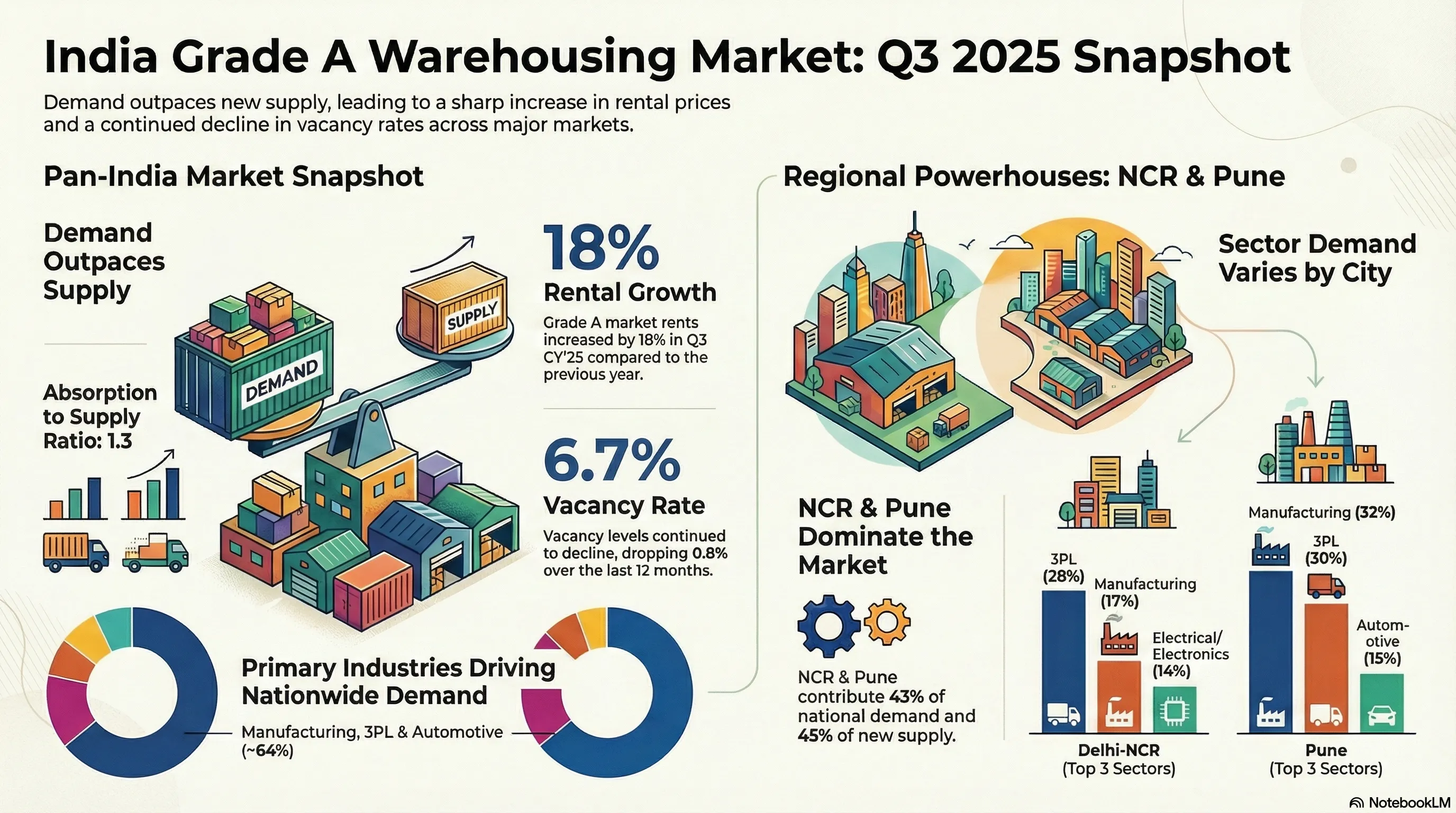
Pan-India Grade A/A+ warehousing demand reached 57.9 million sq ft in the first nine months of CY’25, while new supply stood at 43.5 million sq ft. This puts the absorption-to-supply ratio at 1.3x, a clear signal that tenants are moving faster than developers can deliver new space.
As a result, vacancy levels fell to 6.7% in Q3 CY’25, down 0.8 percentage points year-on-year, continuing a steady multi-quarter decline.
Rents Are Rising—Fast
With demand chasing limited high-quality stock, Grade A/A+ market rents rose 18% year-on-year on a pan-India basis. Weighted average rents have steadily climbed quarter after quarter, reflecting both stronger tenant profiles and a shift toward modern, compliant logistics parks.
In several markets, market rents are now meaningfully higher than passing rents—clear evidence of pricing power shifting toward landlords.
NCR and Pune Lead the Pack
Two regions dominated India’s warehousing story in 2025:
- NCR and Pune together accounted for 43% of total demand
- The same two markets delivered 45% of new supply
This concentration highlights where institutional-grade logistics development is scaling fastest—driven by proximity to consumption hubs, manufacturing clusters, and infrastructure corridors.
Who’s Leasing All This Space?
Demand remains anchored in the real economy rather than speculation:
- Manufacturing, 3PL, and Automotive contributed ~64% of total demand
- E-commerce, retail, electronics, and pharma added depth across metros
Large-format transactions dominate, with the majority of deals exceeding 100,000 sq ft, reinforcing the shift toward consolidated, efficient distribution networks.
City-Level Snapshot (Quick Hits)
- MMR: Tightest market with ~5% vacancy and strong rental momentum
- Pune: Balanced growth, rising rents, and heavy manufacturing-led demand
- Chennai: One of the lowest vacancy markets (~4.3%), driven by automotive and logistics
- Bengaluru: Strong demand growth but higher vacancy (~12%), indicating room for absorption
- Hyderabad & Ahmedabad: Rapid demand growth, especially from pharma, e-commerce, and 3PL
Bigger Picture: A Structural Shift
India’s Grade A warehousing market is no longer just a logistics story—it’s an infrastructure story. With an estimated 385 million sq ft of Grade A/A+ stock expected by end-2025, the sector is becoming a core asset class for institutional capital.
What’s driving it?
- Manufacturing push and supply-chain localization
- GST-led consolidation
- Rising service-level expectations from tenants
- Preference for compliant, large-scale, professionally managed assets
Bottom Line
Q3 CY’25 confirms what the market has been hinting at all year: India is structurally under-supplied in Grade A warehousing. Until supply catches up, expect rents to stay firm, vacancies to remain tight, and institutional interest to deepen.
If residential was the story of the last cycle, logistics and warehousing are quietly writing the next one—steel roofs, high docks, and all.