In three and a half years, if timelines hold, Chandigarh will quietly attempt something it hasn’t done in decades: redefine its role in North India’s public healthcare map.
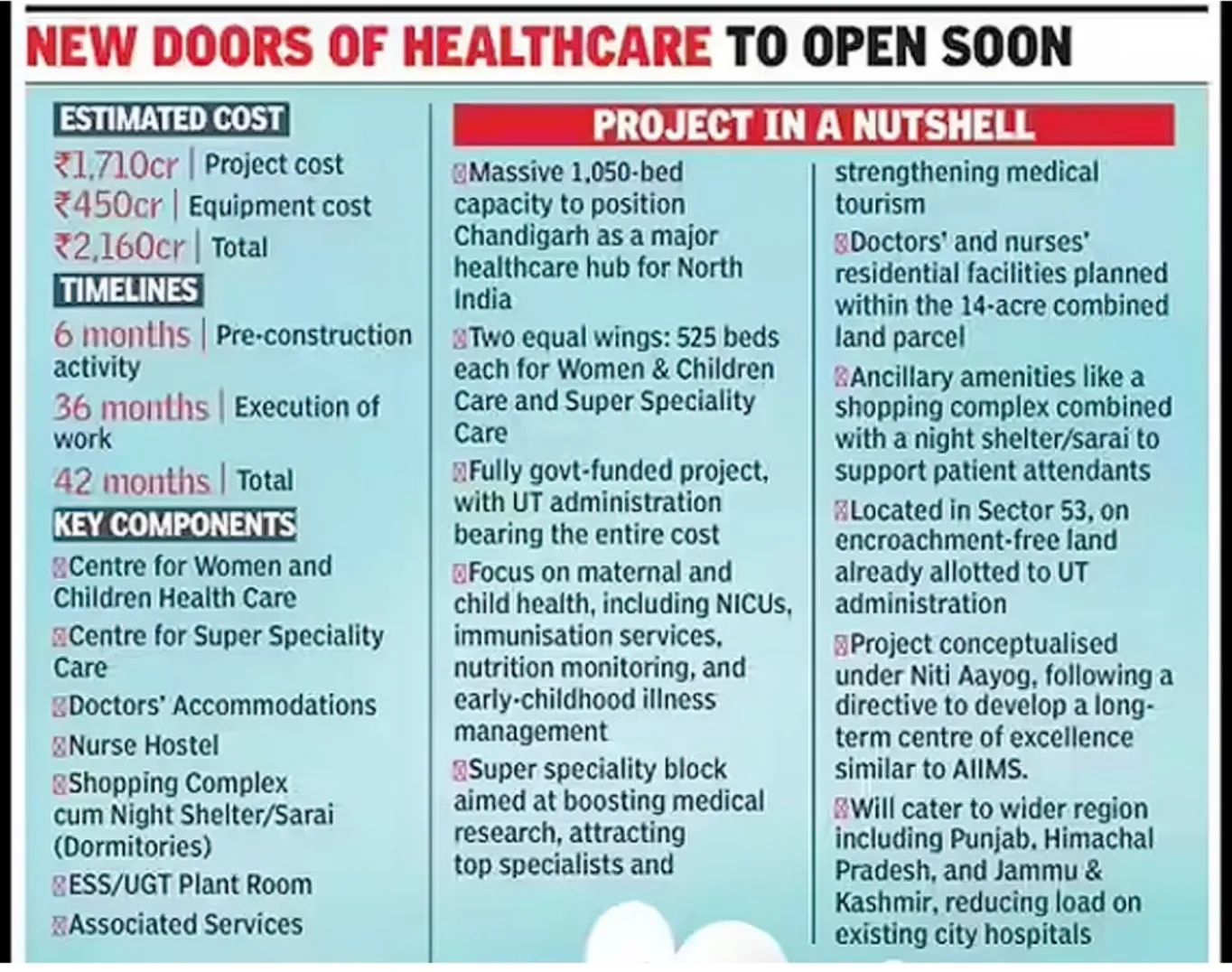
The Union Territory administration has cleared a ₹2,160-crore, fully government-funded Regional Medical Hub—a 1,050-bed facility spread across 14 acres in Sector 53. No PPP. No private operator. No naming rights. Just the state, paying the bill.
On paper, it looks straightforward: two equal halves.
One for women and children.
One for super-speciality care.
525 beds each.
In reality, it’s a course correction.
Why Chandigarh Needs This (Even If It Doesn’t Say So)
Chandigarh already has hospitals—GMSH-16, PGI, GMCH-32. But demand has outpaced design.
PGI, meant to be a tertiary care institute, now handles everything from referrals to routine cases. GMSH-16 was supposed to expand, but that plan stalled. What followed was a push from the Centre: stop patching, start planning.
During a 2024 visit, the Union Home Secretary asked the UT to think long-term—to build something closer to a centre of excellence, on the lines of AIIMS, rather than endlessly stretching existing hospitals.
This project is the outcome of that nudge.
What’s Actually Being Built
The hub will sit on a 10-acre vacant parcel with an additional 4 acres of adjacent residential land—both encroachment-free, already allotted.
The layout is deliberately comprehensive:
- A Women & Children Health Centre focused on maternal care, postnatal support, immunisation, nutrition tracking, and early childhood illness (birth to age five).
- Dedicated NICUs for high-risk newborns.
- A Super Speciality Block aimed at advanced procedures, in-house research, and specialist-driven care.
- On-site doctor residences, a nurse hostel, and staff infrastructure—an implicit acknowledgment that talent retention matters as much as buildings.
- A shopping complex cum night shelter (sarai)—less glamorous, more practical—meant for patient attendants who currently spill onto pavements outside city hospitals.
- Utilities, plant rooms, and backend services that hospitals usually forget until they fail.
Pre-construction will take six months. Execution: 36 months. Total promised timeline: 42 months.
The Unspoken Objective: Regional Load-Balancing
This is not just a Chandigarh project.
The hub is designed to absorb patient flow from Punjab, Himachal Pradesh, and Jammu & Kashmir—regions that currently funnel complex cases into PGI or push patients to Delhi.
If it works, two things happen:
- Pressure eases on existing city hospitals.
- Chandigarh quietly repositions itself as North India’s public healthcare anchor, not just an administrative capital.
That matters.
Healthcare hubs create second-order effects: specialist migration, medical education spillovers, research output, and yes—medical tourism, even if officials prefer the term “advanced care access.”
The Big Risk: Execution Without Drift
At ₹2,160 crore—₹1,710 crore for construction and ₹450 crore for equipment—this isn’t a small experiment. It’s one of the UT’s largest single public investments in recent memory.
The risk isn’t intent. It’s drift.
Delays. Scope creep. Staffing gaps. A hospital that opens on time but operates below capacity because specialists don’t come—or don’t stay.
The administration insists otherwise. Officials speak of Make in India medical instruments, in-house research, and national-level impact. Those ambitions will only matter if the fundamentals—beds, doctors, nurses, systems—work first.
The Bigger Signal
For years, Chandigarh’s growth story has been dominated by housing sectors, periphery roads, and satellite cities.
This project signals something different.
That the next phase of the city’s relevance may come not from where people live—but from where they go when things go wrong.
If the hub delivers what it promises, Chandigarh won’t just be planned well.
It will matter more.